
When the Classroom Is Too Loud: Managing Teacher Sensory Overload Before You Snap
Have you ever stepped into the hallway during independent work time, pressed your back against the cool cinderblock wall, and realized your jaw was clenched so tight it ached?
You are not losing your patience, nor are you failing at classroom management. Your nervous system is simply reacting to an environment that is constantly pushing past physiological human limits.
When background chatter meets scraping chairs, clicking pens, and buzzing fluorescent lights, your brain registers the daily soundscape not as energetic learning, but as an ongoing physical threat.
If you are feeling drained, irritable, or completely spent by 2:00 PM, you are likely experiencing teacher sensory overload. Here is why classroom noise takes such a massive physical toll on educators, and how you can protect your nervous system using simple, no-prep adjustments.
Get Your Free Breathing Exercises & Mindfulness Activities Ebook
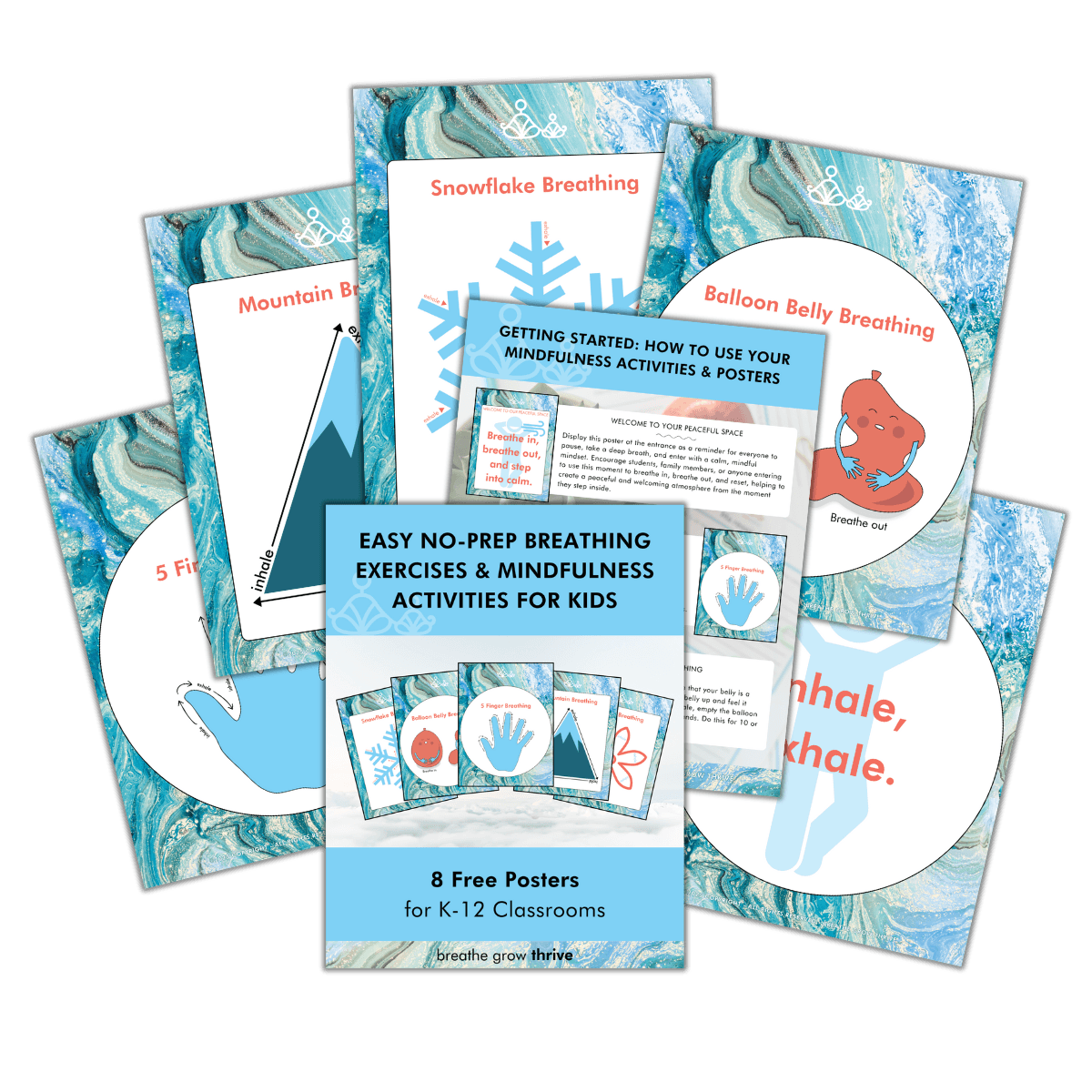
Help your students (and yourself!) stay calm, focused, and self-regulated—with just a few minutes of breathing exercises each day.
8 beautiful, ready-to-print posters for easy classroom integration
No prep required—just download and get started
Evidence-based strategies to reduce stress and promote emotional well-being
No prep. No stress. Just download and start creating a calmer, more focused classroom today.
THE SCIENCE OF ACOUSTIC STRAIN: WHY YOUR BODY IS ON HIGH ALERT
Classrooms are notoriously intense sensory environments. Research from th World Health Organization (WHO) emphasizes that background noise in classrooms should not exceed 35 decibels to maintain a healthy, functional space. Yet, standard K-12 classrooms routinely operate at 75 to 80 decibels during small-group work or transitions.
When environmental noise routinely exceeds safe thresholds, your sympathetic nervous system kicks into fight-or-flight mode. Your brain triggers an automatic release of cortisol and adrenaline. This elevates your heart rate and keeps your body on high alert.
This dynamic leads directly to cognitive fatigue and emotional exhaustion. It's not a personal failure if loud chatter makes you want to climb the walls. It's an automatic biological response to chronic noise exposure.
ENVIRONMENTAL TWEAKS TO LOWER CLASSROOM NOISE LEVELS
You cannot control every sound in a room full of energetic students, but you can make quick physical adjustments to break up acoustic echoes and reduce sensory friction.
1. ESTABLISH PHYSICAL QUIET ZONES
Designate a specific "low-sensory corner" or quiet station in your room. Equip it with soft seating or visual dividers where students can complete independent reading without creating cross-room chatter. For specialized evidence on tailoring low-sensory environments and visual supports, explore the Middletown Centre for Autism Sensory Strategies.
2. OPTIMIZE SEATING AND LAYOUT
Hard, reflective surfaces amplify sound. Move desks away from bare cinderblock walls or high-traffic doorways where sound echoes most intensely. Grouping desks in small clusters rather than long rows can also help contain conversational volume to localized pockets.
3. USE VISUAL ANCHORS INSTEAD OF YOUR VOICE
Trying to speak over a noisy room forces you to strain your vocal chords and adds another layer of sound to an already overstimulated space. Replace verbal requests for quiet with visual cues:
Silent call-and-response hand signals.
Saying things at a low volume like "If you can hear this, take a deep breath".
Flipping lights on or off.
Flip charts or visual schedule cards showing the current volume expectation (e.g., "Whisper Voice" vs. "Presenter Voice").
Visual noise meters on your display board so students can self-monitor.
Grab our free, ready-to-use printable Breathing Posters ebook for the classroom.
PROTECTING YOUR OWN SENSORY BOUNDARIES
Managing teacher stress and burnout requires recognizing that your personal nervous system matters just as much as your lesson plan.
Practice Micro-Decompression: When students are working silently, resist the urge to rush around grading or cleaning. Take a short moment for yourself first. Plant both feet flat on the floor, drop your shoulders away from your ears, and take three deep abdominal breaths.
Model Sensory Boundaries: Normalize talking about sensory needs with your class. You might say, "Our room is very loud right now, and my brain needs a low-volume moment so I can think clearly. Let's all take a quiet pause together."
RESTORING CALM THROUGH CO-REGULATION
When a classroom reaches a fever pitch, especially after unstructured times like recess, lunch, or physical education, raising your voice to regain control only increases total noise.
As educators, we need to act as a thermostat, not a thermometer. A thermometer merely reacts to the temperature in the room; a thermostat sets the temperature. You can lead your class back to calm through structured, collective co-regulation.
When you prioritize co-regulation, you do not need to yell over the noise or issue punitive warnings. You simply guide everyone through a shared transition that lowers ambient sound levels systemically.
LOWER THE VOLUME INSTANTLY
You do not have to exhaust your voice or sacrifice your well-being just to get through a loud afternoon. Instead of struggling to quiet the room on your own, let guided audio do the heavy lifting for you.
When you press play on our ready-to-use audio tools, your entire class receives a clear auditory anchor that brings down ambient noise levels without any prep work.
Take a deep breath and reclaim the quiet in your school day. Try our free The Reset Audio Series today for a quick, structured transition that restores calm to your day and gives your overstimulated nervous system the break it deserves!
Loving this? Save it to Pinterest so you can easily refer back to it during the school week. 📌
Do you have a suggestion for a topic you think we should cover? Email us at hello@breathegrowthrive.com.
If this blog post resonated with you, share it with a teacher friend. Sharing is caring! 🧡
You Might Also Like...

Thrive in a calm, focused, and well-managed K–12 classroom with evidence-based, no-prep resources that fit seamlessly into your busy school day.
NAVIGATE
GET 8 FREE BREATHING EXERCISES POSTERS STRAIGHT TO YOUR INBOX
© 2025 COPYRIGHT - ALL RIGHTS RESERVED
© 2026 COPYRIGHT - ALL RIGHTS RESERVED