
Thermostat vs. Thermometer: How Classroom Co-Regulation Transforms Your Daily Environment
Ever walked into your classroom and felt the collective tension instantly spike your own heart rate? You are trying your absolute best to deliver a lesson, but instead, you find yourself constantly reacting to a cascade of student outbursts and high-energy disruptions. It feels completely exhausting to spend your entire day playing emotional catch-up, doesn’t it?
Navigating these challenges is the primary source of teacher stress and burnout, leaving so many of us running on empty before the lunch bell even rings. When classroom noise levels routinely exceed the WHO recommended limit of 35 decibels, it triggers a state of constant sensory overstimulation. Your nervous system perceives this non-stop noise as a literal threat, leading to severe cognitive fatigue, emotional exhaustion, and that heavy sense of depletion at the end of the school day.
But what if you could stop just reflecting the heat in your room and actually reset the climate?
Get Your Free Breathing Exercises & Mindfulness Activities Ebook
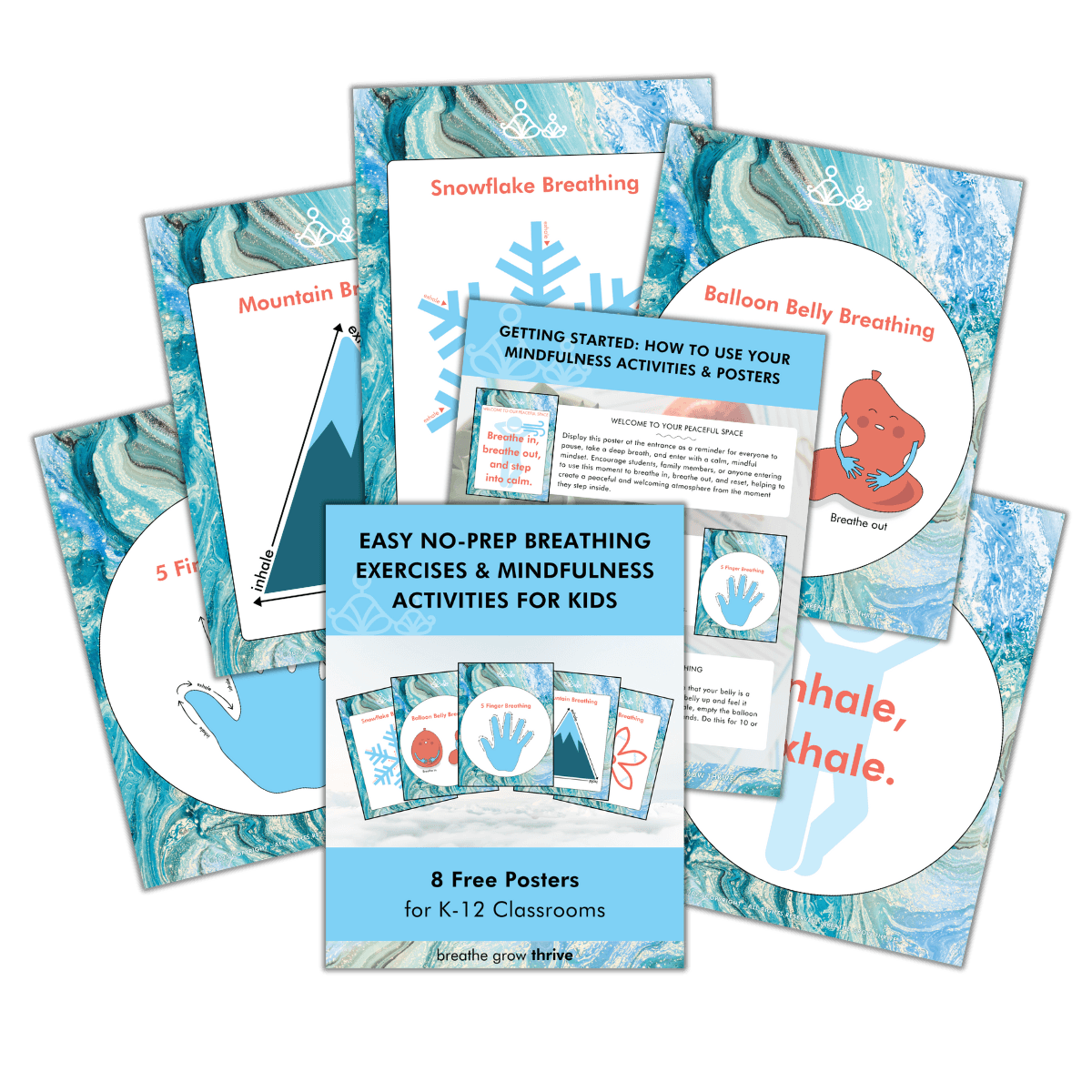
Help your students (and yourself!) stay calm, focused, and self-regulated—with just a few minutes of breathing exercises each day.
8 beautiful, ready-to-print posters for easy classroom integration
No prep required—just download and get started
Evidence-based strategies to reduce stress and promote emotional well-being
No prep. No stress. Just download and start creating a calmer, more focused classroom today.
THE MYTH OF THE CLASSROOM THERMOMETER
Culturally, educators are conditioned to believe that to be a "good teacher," we must sacrifice our personal lives, health, and boundaries to maintain absolute control. We are told to focus on rigid group compliance. Traditional school expectations essentially turn us into thermometers. A thermometer merely reacts to the temperature in the room, rising and falling helplessly with the surrounding chaos. When student energy spikes, the teacher’s stress spikes to match it, creating an escalating loop of tension.
To break this exhausting cycle, we have to shift our paradigm toward classroom co-regulation. Look at how a room's emotional climate shifts based on our internal state:
The Thermometer Approach (Reactive State): When we react out of our own flight-or-fight response, students instinctively mirror that tension. The result? An escalating loop of classroom chaos and sudden behaviour spikes.
The Thermostat Approach (Regulated State): When we choose to hold a calm presence, students naturally begin co-regulation alongside us. The result? The room rapidly stabilizes and gently guides everyone back to a baseline of safety. 🙌
THE SCIENCE OF TEACHER NERVOUS SYSTEM REGULATION
Real, sustainable change does not begin with a new discipline policy or a complicated reward chart. It begins within your own nervous system.
The biological reality is that a child’s developing brain does not yet possess the structural pathways required for independent, consistent self-regulation. Instead, they rely heavily on an adult's calm, stable presence to feel safe and mirror emotional stability. This biological process is what we call co-regulation.
When a student is highly reactive, our own survival instincts naturally fire up, sending us straight into fight-or-flight. If we respond from that place of survival, we pour gasoline on the fire. To unlock a peaceful room, we have to remember a scientific truth:
Calm is just as contagious as panic!
BECOMING THE THERMOSTAT WITH PROACTIVE TOOLS
A thermostat does not match the room's panic; it sets the desired temperature and actively pulls the environment back to a baseline of safety. You have the power to act as the emotional thermostat for your classroom.
When a behavioural storm hits, you can utilize immediate, ready-to-use mindful strategies to de-escalate the room without needing to raise your voice or issue ultimatums:
The Strategic Pause: Before responding to a disruption, pause for three full seconds. This simple gap stops your automatic fight-or-flight reaction and protects your nervous system.
Low and Slow Speech: Drop your vocal volume slightly and slow your cadence. Lowering the auditory decibels in the room instantly signals safety to overstimulated student brains.
Verbal Validation: Acknowledge the emotion behind the behaviour. Saying, "I can see you're feeling really frustrated right now, and it's okay to feel that way," removes the fuel from an emotional fire.
Grab our free, ready-to-use printable Breathing Posters ebook for the classroom.
LOWERING THE TEMPERATURE WITH THE RESET
When the emotional climate in your room starts to boil over, you shouldn’t have to scramble for a solution, write a behaviour referral, or spend your entire evening spinning through a mental loop of student needs. You deserve a moment to breathe, too. The heavy silence you feel when you close your car door at the end of the day shouldn't be filled with anxiety over second period.
This is the "invisible tax" of teaching, and it is a biological state of high-alert that your body simply doesn't know how to turn off. It isn't a personal failing, and it isn't something a bubble bath can fix!
That is why we created a tool designed to help you step away from the reactive thermometer role entirely and claim your mental energy back. With The Reset, you join a free 5-day audio series designed specifically for the busiest weeks of the school year. It requires zero extra capacity, features no screens or homework, and takes under four minutes a day.
When the school day ends, you don't need to carry the stress home, you just have to press play on these short, high-impact lessons during your commute or your walk to the car. Let our no-prep biological tools send a safety command to your brain so you can finally leave "teacher brain" at the school gates. 🙌
Ready to shift your classroom experience from reactive spikes to proactive peace, and protect your evenings?
Click here to access The Reset for free right now!
With calm and appreciation,
The Breathe Grow Thrive Team
P.s.: Managing a classroom shouldn't mean sacrificing your own well-being or your "me time" after contract hours. The Reset is completely ready-to-use and free, meaning you get to prioritize your own teacher stress and burnout recovery in less time than it takes to boil a kettle.
P.p.s.: Want to explore the deeper research behind these shifting dynamics? Check out Edutopia's Guide to Emotion Co-Regulation in Discipline to see how shifting away from traditional control models protects both teachers and students. You can also view systemic social-emotional frameworks over at The Collaborative for Academic, Social, and Emotional Learning (CASEL).
Loving this? Save it to Pinterest so you can easily refer back to it during the school week. 📌
Do you have a suggestion for a topic you think we should cover? Email us at hello@breathegrowthrive.com.
If this blog post resonated with you, share it with a teacher friend. Sharing is caring! 🧡
You Might Also Like...
Thrive in a calm, focused, and well-managed K–12 classroom with evidence-based, no-prep resources that fit seamlessly into your busy school day.
NAVIGATE
GET 8 FREE BREATHING EXERCISES POSTERS STRAIGHT TO YOUR INBOX
© 2025 COPYRIGHT - ALL RIGHTS RESERVED
© 2026 COPYRIGHT - ALL RIGHTS RESERVED